Faces From the Forgotten: How Luray's Damaged Old Photographs Are Finally Getting Their Stories Back
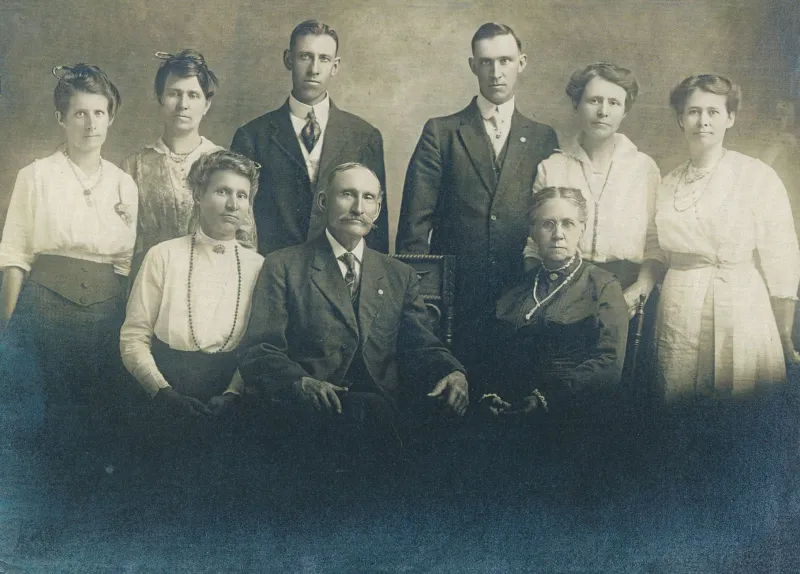
There's a particular kind of sadness to an unlabeled photograph. A woman stands in front of a building you almost recognize. A child squints into the sun on a porch that no longer exists. A man in his Sunday best stares back at you from 140 years away, and nobody left alive knows who he is.
Luray has thousands of these images — or at least, what's left of them. Cracked daguerreotypes. Cabinet cards with water damage bleeding across half a face. Glass plate negatives with entire corners snapped off. For a long time, most of these fragments ended up in the trash, donated to thrift stores, or sold for a dollar at yard sales to people who liked the aesthetic without knowing the history. But that's starting to change.
What Survives When Nothing Was Saved
Photography arrived in the Shenandoah Valley not long after it arrived anywhere in America. By the 1860s, itinerant photographers were making their way through rural communities like Luray, setting up temporary studios in rented rooms or the back of wagons, offering families the chance to have their likenesses preserved for a few cents. For many working families in Page County, a single photograph represented a significant expense — something saved for, not repeated.
That financial weight is part of why so many images were kept at all. But it's also why so many were eventually lost. When families fell on hard times, moved west, or simply ran out of people who remembered who was in the picture, those photographs became orphans. Some ended up in local antique shops. Others were donated in bulk to the Page County Heritage Association or the Luray-Page County Library without any accompanying documentation.
What nobody expected was how much information was still locked inside those damaged images — waiting for someone with the right tools and enough patience to find it.
The Volunteers Doing the Digging
Over the past several years, a loose network of local history enthusiasts — some affiliated with established archives, some just deeply curious people with laptops and spare weekends — has been quietly working to restore and identify Luray's orphaned photographs. They call what they do "visual genealogy," though the term doesn't quite capture the blend of art restoration, historical research, and community storytelling involved.
The process usually starts with the image itself. High-resolution scanning reveals details invisible to the naked eye — a business sign reflected in a window, a street number barely legible on a doorframe, a regimental insignia on a uniform collar. From there, the work becomes almost like archaeology. Cross-referencing with Sanborn fire insurance maps, property records, and old newspaper advertisements from the Page News and Courier, volunteers have been able to place specific photographs on specific streets, sometimes narrowing down a date range to within a few years.
Identifying the people in those images is harder, but not impossible. Clothing styles, jewelry, and photographic formats all carry date markers. A tintype formatted a particular way suggests a date range. A woman's collar style narrows it further. When census records show only a handful of families living on a given street in a given decade, the field of candidates shrinks fast.
"You get this moment," one volunteer described, "where everything clicks and you realize the man in the photograph is somebody's great-great-grandfather who nobody in the family even knew existed as a real person. Not just a name on a document — an actual face."
What the Images Show That Records Don't
Official historical records tend to capture life at its formal edges — births, deaths, property transfers, legal disputes. Photographs catch everything in between. And what Luray's recovered images are revealing about everyday life in the late 19th and early 20th centuries is quietly rewriting some assumptions about the community.
Several restored images have shown African American families in settings that contradict the narrative of absolute segregation that sometimes flattens the complexity of Southern rural life. A recovered cabinet card shows two women — one white, one Black — seated together in what appears to be a domestic setting, their body language suggesting genuine familiarity. Nobody knows their names yet. But the image itself pushes back on oversimplified stories.
Other photographs document commercial Luray in ways that written records barely touch. A partially restored glass plate negative shows a stretch of Main Street that predates the earliest known commercial photographs of the town, capturing storefronts and signage that historians had no visual reference for. A series of damaged prints from what appears to be the 1890s shows women engaged in what looks like organized agricultural work — not a church social, not a domestic scene, but labor — in a way that challenges assumptions about women's economic roles in rural Valley communities.
None of these images came labeled. All of them required work to read.
Modern Tools, Old Instincts
The technology available to today's volunteer archivists would have seemed like magic to the photographers who originally made these images. AI-assisted restoration software can reconstruct damaged areas of a photograph with reasonable accuracy. Spectral imaging — the same technology used to read ancient manuscripts — can sometimes recover detail from photographs where the surface has deteriorated beyond what visible light can show. Facial recognition tools, used carefully and with appropriate skepticism, can sometimes suggest connections between unidentified subjects and known photographs in other collections.
But experienced volunteers are quick to point out that technology only gets you so far. The real work is still human. It's knowing which county deed books to pull. It's recognizing a particular style of fence construction that was common in one part of Page County but not another. It's calling an 80-year-old woman in Front Royal because she mentioned once that her grandmother had a photograph of a building that no longer stands.
"The software helps," one archivist noted, "but honestly, the most important tool is still just talking to people."
Keeping What's Found
One of the ongoing challenges facing this informal network is the question of where restored and identified photographs ultimately live. The Page County Heritage Association maintains a collection, and the local library has archival capacity, but neither has the staffing to manage a large-scale digitization and cataloging project on its own. Right now, much of the work exists on personal hard drives, shared Google folders, and volunteer-maintained databases that could disappear if the right people stop showing up.
There's a push among some in the community to establish a more formal digital archive — something publicly searchable, properly backed up, and connected to national genealogical databases so that descendants anywhere in the country could potentially find a face they recognize. It hasn't happened yet, but the conversation is gaining momentum.
In the meantime, the photographs keep surfacing. Estate sales in Luray and the surrounding county turn up new finds every few months. A box donated to a church rummage sale. A stack of prints discovered during a home renovation. Each one another face from the community's past, waiting to be recognized.
Some of them will get their names back. Some won't. But even the ones that stay anonymous are telling Luray something important — that the lives lived here were worth photographing, worth preserving, and worth the effort it takes, more than a century later, to look closely enough to finally see them.