Where the Bell Still Rings: The One-Room Schoolhouses That Built Luray's Heart
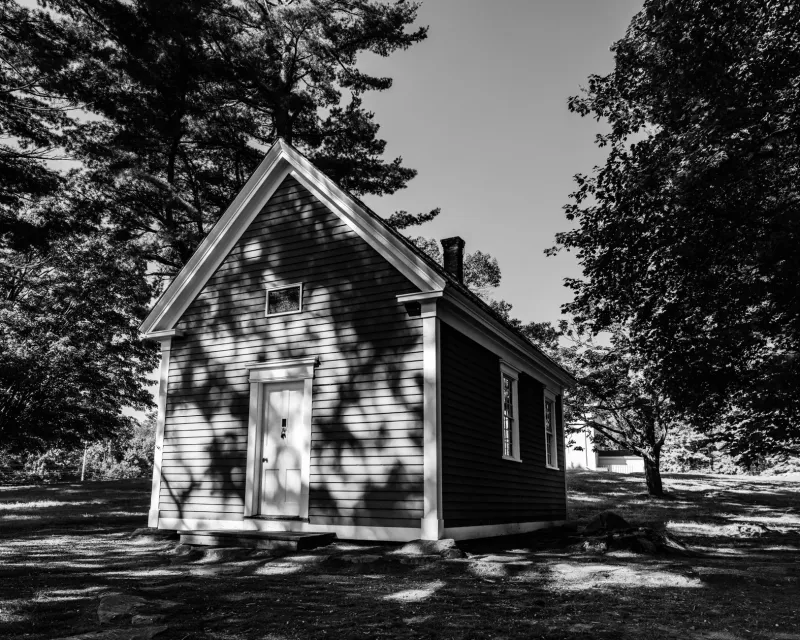
There's a particular kind of quiet that settles over an old schoolhouse in winter. The wood has grayed. The bell, if it's still there at all, hangs silent. But step inside one of the surviving one-room schoolhouses tucked into the hollows and hillsides around Luray, and something shifts. You can almost hear it — chalk on slate, the shuffle of boots on pine floors, a teacher calling order over the wind coming down off Massanutten.
For much of the nineteenth and early twentieth centuries, these modest buildings were the beating heart of Page County's rural communities. They weren't just classrooms. They were polling places, church halls, community meeting rooms, and sometimes the only public gathering space for miles. Understanding them means understanding something essential about how Luray's people survived, adapted, and held onto who they were through generations of change.
Small Buildings, Big Responsibilities
At their peak, Page County had dozens of one-room schoolhouses operating simultaneously — some little more than repurposed log structures, others purpose-built frame buildings with modest bell towers and carefully placed windows designed to maximize natural light. Most served students ranging from first grade through what passed for eighth grade, all sharing a single room, a single teacher, and whatever books the county or local families could provide.
The logistics alone were staggering. A teacher — often a young woman in her late teens or early twenties, frequently a recent graduate of a nearby normal school or academy — might manage thirty or forty students spanning a decade in age. Older students helped younger ones with reading primers while the teacher worked arithmetic problems on the board with the middle grades. It was organized chaos, and somehow, it worked.
"My grandmother talked about her teacher, Miss Alma, like she was a figure out of legend," says Patricia Meadows, whose family has farmed the same land outside Luray for five generations. "She said Miss Alma knew everything — history, geography, how to set a broken finger. People brought her their problems. She was like the whole county's brain."
That wasn't unusual. In communities where formal education was scarce, the schoolteacher occupied a singular social position. She — and it was usually she, because male teachers tended to move on to better-paying work — was often the most formally educated person in a five-mile radius. Families deferred to her judgment on matters well beyond spelling and long division.
The Architecture of Community
If you know where to look, a handful of these schoolhouses still stand in and around the Luray area, and visiting them is one of the more quietly moving heritage experiences the valley has to offer. They're not grand. That's exactly the point.
The typical Page County schoolhouse measured somewhere between twenty and thirty feet long, with a single door at the front and a wood stove centered near the middle of the room. Outhouses stood at a respectful distance out back. A small entry vestibule — called a "cloakroom" in most records — gave students a place to hang their coats and stomp mud from their boots before entering. The details are humble, but they speak to a community that took learning seriously enough to build a dedicated space for it, even when resources were desperately thin.
What's striking, looking at old county maps and school census records held at the Page County Heritage Foundation, is how deliberately these buildings were placed. They almost always sat at a crossroads or near a mill, positioned to be accessible to the greatest number of families without favoring any single farm or settlement. The geography of education in Page County was, in its own way, a geography of fairness.
After Hours: When the Schoolhouse Became Something Else
Friday evenings in the fall. That's when the schoolhouse transformed.
Community suppers, spelling bees, debate societies, and traveling lectures all found a home in these buildings after the children had gone. Political candidates stumped from the teacher's platform. Revival preachers borrowed the space between regular Sunday services. Neighbors who might go weeks without seeing each other gathered here to argue, laugh, mourn, and celebrate.
"The schoolhouse was where you found out what was happening," explains James Burner, a local historian who has spent years documenting Page County's rural institutions. "News traveled slow back then. But people knew that if something important was going on, somebody would post a notice on the schoolhouse door. It was the community bulletin board, the town hall, and the social club all rolled into one."
For Black communities in Page County, this dual function carried even deeper significance. Segregated schoolhouses — chronically underfunded and often housed in structures that white schools would have condemned — nonetheless served as irreplaceable centers of cultural life. Teachers in these schools bore an almost impossible burden: delivering a quality education with a fraction of the resources while also holding their communities together against the pressures of Jim Crow Virginia. Their stories deserve far more attention than they've historically received, and local researchers are only beginning to recover them from church records, family archives, and oral histories.
What Survives, and Why It Matters
Not many of these buildings made it to the present day. Consolidation came fast to Page County in the mid-twentieth century, and most one-room schools were abandoned, repurposed, or simply left to fall. A few became storage barns. Some were torn down when the land changed hands. Others just quietly disappeared into the landscape, their lumber reused, their foundations swallowed by decades of weeds.
But a small number survive, and local preservation advocates are working to document and protect them before the last ones are gone. The Page County Heritage Foundation maintains records on several structures, and driving the back roads around Luray with a county map from the 1920s is a surprisingly rewarding way to find what's left — a stone foundation here, a weathered clapboard wall there, occasionally a building still intact enough to step inside.
For heritage travelers, these sites offer something that bigger, more polished attractions can't quite replicate: the feeling of standing in a place where ordinary people did extraordinary things without any expectation of being remembered for it. No plaques. No gift shops. Just the ghost of a bell and the faint impression of chalk dust in the air.
Carrying the Lesson Forward
Luray's one-room schoolhouses weren't perfect institutions. They reflected the inequalities of their era as faithfully as they reflected the aspirations. But they also embodied something worth honoring — the conviction that a community's future depended on its willingness to invest in its children, even when that investment meant building a plain wooden room at a crossroads and trusting a twenty-year-old teacher to fill it with possibility.
That conviction didn't disappear when the buildings closed. It moved into the consolidated schools, into the families who carried their educations with them across the valley and beyond, into the descendants who still tell stories about Miss Alma and teachers like her with something close to reverence.
The bell may be silent now. But if you listen at the right crossroads on a quiet afternoon, you might still hear what it was calling everyone toward.